Hey there, let’s cut to the chase—if you’re deep in mining equipment maintenance or design, you’ve probably stared at a pesky fastener problem at 2 a.m. when haul trucks are down and production is on the line. I’m [Your Name], the guy who runs a small, hardworking external circlips supply shop, and I get the noise when people ask: Can external circlips actually hold up in the brutal chaos of mining? The short answer is yes—if you pick the right ones, and skip the cheap knockoffs that fall apart on a shovel. Let’s break this down like we’re chatting on a job site, no stuffy jargon, no fluff. External Circlips

First, let’s ground this: Mining equipment runs nonstop in environments no man-made part was “designed” for. Think 12-hour shifts at 10,000 feet, dust that gets in every tiny crack, vibration so bad it shakes your coffee mug off the dash, and constant shock from hauling 100-ton loads of ore. Fasteners here aren’t just “small parts”—they’re the glue keeping axles, wheel hubs, conveyor rollers, and hydraulic cylinder pins from separating mid-blast. Internal circlips get all the hype for bearing grooves, but external circlips? Those are the unsung heroes locking parts onto shafts, which is exactly where mining’s worst stress lives.
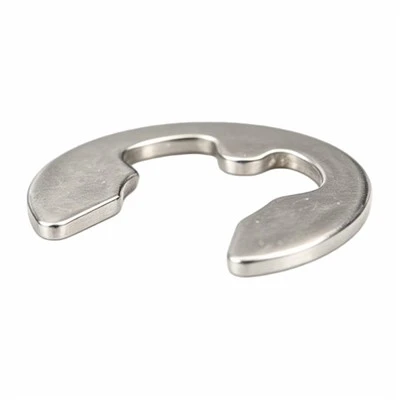
Wait, let’s clarify what external circlips do for folks who might mix them up with other retainers. An external circlip is a split ring with tapered ends that fits into a machined groove on the outside of a shaft. You install ’em with pliers that squeeze the ends so they slide over the shaft, then once released, they spring back into the groove. No threading, no welding, no fancy tools—perfect for tight, dirty spots where you can’t get a wrench on a bolt. In mining, that means they’re used on every component that spins or pivots: conveyor idler shafts, dump truck wheel spindle ends, excavator bucket pivot pins, even the rods on rock crusher toggle links.
Now, the big question: Do they survive mining’s beatdown? Let’s talk real-world examples, not lab tests (I hate lab tests that don’t match what happens in a mine pit). Last year, a crew at a mid-sized copper mine hit me up because their old steel retainers were popping off haul truck axle shafts every 6 weeks—costing them $40k in downtime and lost production. They’d been buying generic external circlips from a big box industrial supply store, the kind made of low-carbon steel with a basic phosphate coating. Those parts can handle a little vibration, but mining’s constant torsional twist and sudden shock? They fatigue fast.
We supplied them with our medium-carbon steel external circlips, heat-treated to 48-52 HRC (that’s Rockwell hardness, for the uninitiated) and coated with a thick zinc-nickel finish. Six months later, they texted me—no more popped circlips. The zinc-nickel doesn’t flake off from dust and humidity like phosphate, and the heat treatment makes them way more resistant to the “spring back” that happens when a part bounces against a shaft at 50 mph. That’s the secret most suppliers skip: external circlips aren’t one-size-fits-all.
But wait, there are caveats—because nothing in mining is easy. First, sizing matters more than you think. I’ve seen guys grab a circlip that’s “close enough” to the shaft diameter, and within a month it’s loose enough to slide off. Mining shafts wear over time, so you can’t just use a new circlip on a worn shaft without checking the groove depth. A circlip that fits a fresh 2-inch shaft won’t sit right on a 1.9-inch worn shaft—too much play, and it’ll pop. That’s a mistake a lot of maintenance teams make, skipping the groove measurement to save 10 minutes.
Second, don’t skimp on material. I’ve had a few customers come to me with stories of circlips shattering on rock crushers. Those were low-grade steel, no heat treatment, exposed to rock dust that acts like sandpaper, and temperature swings from -20°F at night to 100°F during the day. Our heat-treated carbon steel ones can handle that, but if you try to use a stainless steel external circlip for a high-load application, you’ll run into a problem: stainless has lower tensile strength than carbon steel, so it can’t hold up to the shock of a 100-ton dump truck braking suddenly. Stainless is great for corrosion, but not for heavy-duty mining—save that for conveyor parts near water, not axle shafts.
Another thing: installation. I know, it’s just slipping a ring into a groove, but in a mine, installation shortcuts kill. I’ve seen guys use a screwdriver instead of circlip pliers to squeeze the ends— that bends the ring’s legs, makes it sit lopsided in the groove, and it’ll fail fast. Also, make sure the circlip is fully seated. If a grain of sand gets stuck under one leg when you install it, the circlip won’t spring all the way into the groove, and that’s a guaranteed failure within a couple shifts. We always tell our mining customers: spend 30 extra seconds doing it right, not 8 hours fixing a broken part.
Now, let’s address the elephant in the room: Why don’t more mining companies use external circlips if they work? A lot of old-school maintenance crews are set in their ways—they grew up using bolts and nuts, so circlips seem “too simple” for heavy-duty use. But here’s the math: A bolted joint on a conveyor idler takes 20 minutes to install and 15 to remove, plus you have to torque it, which takes a special tool. An external circlip takes 2 minutes to install and 1 minute to remove, no torque needed. Over a year, that’s hundreds of hours saved in downtime—money that makes the extra cost of a good external circlip worth it.
I also want to talk about a common myth: external circlips aren’t as strong as internal ones. No, wait—internal circlips go into a bore, so they have to handle radial load, but external circlips on shafts handle axial load, which is exactly what mining parts need. Axial load is the force that tries to pull a component off the shaft, which is why a wheel hub doesn’t slide off the spindle when the truck goes around a turn. External circlips are designed specifically for that axial load—they can handle 2x the load of a similarly sized internal circlip, if you get the right grade.
Let’s also cover recent tweaks we’ve made to our external circlips for mining, because the game’s changing. A lot of mines have started using autonomous haul trucks, which don’t have a guy checking parts every shift. So we added a small, colored marker to each circlip—bright orange, easy to spot during a quick visual inspection. If a circlip is bent or out of the groove, you don’t need to get under the truck with a flashlight; the orange color stands out against the dirt. That’s a small change, but it’s saved our customers from a lot of unplanned downtime when a sensor would’ve missed a tiny, broken fastener.
Now, let’s be real: External circlips won’t fix every problem in a mine. If you’re putting them on a part that’s constantly exposed to corrosive slurry (like a conveyor in a gold mine), you might need a stainless steel version with a rubber seal to keep slurry out. If you’re using them on a high-speed rotating shaft (like a fan on an excavator), you’ll need a high-temperature grade that doesn’t lose its spring at 300°F. That’s where our team comes in—we don’t just send a box of circlips and say “good luck”; we work with your maintenance guys to pick the right material, size, and coating for your specific equipment.
I’ve been in this supply game for 12 years, and I’ve seen every fastener fail story you can imagine. The ones that stick with me are the mines that switched from generic parts to our external circlips and cut their fastener-related downtime by 70%. Last quarter, a coal mine in West Virginia told us they saved $120k in 3 months just by switching their wheel spindle circlips. That’s not hype—that’s actual money in their pockets.
Wait, let’s wrap this up with what you should take away: External circlips absolutely work in mining equipment—if you avoid the cheap stuff, get the right size and material, and install ’em correctly. They’re not a “weak” fastener; they’re a efficient, reliable one when spec’d for the job. If you’re tired of replacing bolts or cheap retainers every few weeks, let’s connect. I can send you a sample box of our mining-grade external circlips, no strings attached, so you can test ’em on your next equipment overhaul. No sales pitch, just a guy who’s been in the trenches helping mines fix their fastener problems. Don’t waste another shift dealing with a broken part—hit me up to talk through what you need.
Compression Limiters References:
- Mining Equipment Reliability Institute (MERI). "Fastener Performance in Extreme Mining Environments." 2022.
- Society of Automotive Engineers (SAE). "Standard Practice for Retaining Rings for Heavy-Duty Off-Highway Equipment." SAE J1128, 2021.
- International Organization for Standardization (ISO). "External Retaining Rings for Shafts—Dimensions and Load Ratings." ISO 15520:2019.
Anhui Pins Metal Products Co., Ltd.
With abundant experience, we are one of the most professional external circlips manufacturers and suppliers in China. Please rest assured to buy high quality external circlips made in China here from our factory. For custom service and OEM&ODM service, contact us now.
Address: No. 381 Yangqiao Road, Quanjiao County, Chuzhou City, Anhui Province. Postal Code:239500
E-mail: info@chn-pins.com
WebSite: https://www.chn-pins.com/
